Stoll & Wolfe Pure Rye Single Barrel Cask Strength

I’d like to thank Stoll & Wolfe and their PR partners for providing this sample bottle with no strings attached.

IMAGE: Stoll & Wolfe Distillery Pennsylvania Single Barrel Rye Whiskey, 100% Pure Rye, 107 proof, photographed on a snowy deck with warm amber whiskey glowing in winter light.

Hello my friends. Tonight we have a real treat for you. Stoll & Wolfe Pure Rye Single Barrel Cask Strength is described by the distillery as an interpretation on the historic Monongahela-style of Rye Whiskey that was once much more common than it is today. It was a rye whiskey developed along the Monongahela River, which flows through West Virginia and Western Pennsylvania before joining the Allegheny at Pittsburgh to form the Ohio River.

Now, being in Lititz, PA, Stoll & Wolfe aren’t necessarily very close to that Monongahela River Valley (being about as close to it as I am to the U.P. of Michigan from here in the Twin Cities of Minnesota), but that doesn’t mean they can’t have a lot of state pride in their regional whiskey style. I know I would.

But, to me as a history nut, the most intriguing thing about this whiskey is the guy who helped start the company—and has his name on the bottle. Dick Stoll was the last distiller at a (now) pretty famous Pennsylvania distillery. It went by many names over the years, but the two that are most well known these days are Bomberger’s Distillery and Michter’s Distillery (this was back before the current owners of the Michter’s name acquired the lapsed trademark and started making their own pretty darn tasty whiskeys under the name). Here is the brief synopsis quoted from the Stoll & Wolfe website:

Dick Stoll’s roots stretch back to his tenure at the historic Pennsylvania Michter’s Distillery. There, under the mentorship of Master distiller C. Everett Beam, Stoll honed his skills and mastered the particular style of Pennsylvania whiskey distillation.

Despite Pennsylvania Michter’s closure in the 1980s, Stoll’s passion for both whiskey and the region has endured. As a capstone to his career, he partnered with Avianna and Erik Wolfe to revive the historic legacy right here in Lititz, Pennsylvania.

I’ve been reading a lot about Mr. Stoll over the course of the last couple of days in preparation for this review. I’d do a hell of a lot worse than these legendary Whiskey writers so I’m just going to point you to them instead. Here is Lew Bryson’s remembrance of Dick Stoll upon the occasion of his death in 2020. And of course, the book that brought my attention to the history of the Pennsylvania Michter’s Distillery and those that worked there Chuck Cowdery’s The Best Bourbon You’ll Never Taste (I also reviewed said book shortly after it was released, in case you wonder what I thought of it back in 2012).

Now, before you go read all those links, let’s get into the reason we are all here. The actual whiskey. Stoll & Wolfe Pure Rye Single Barrel Cask Strength was made from a mash bill of 80% Rosen Rye and 20% malted rye. This rye strain was almost lost to history until local farmers worked with the distillery to recover it. The rye is made using a sweet mash process that doesn’t use any “setback” from previous runs to help maintain pH levels. It’s a trickier process, as without the proper pH levels the mash could get infected by undesirable non-yeast organisms. It’s a much older mashing process, but it was the one most often used in Monongahela-style rye. The whiskey is bottled at 107 proof and is available from the distillery website for $78.15 per 750 mL bottle. Now let’s see how it tastes.

Stoll & Wolfe Pure Rye Single Barrel Cask Strength

Purchase Info: This sample was provided to me at no cost for review purposes. This item is available for nationwide shipping on the distillery website for $78.15 for a 750 mL bottle.

Price per Drink (50 mL): $5.21

Details: Barrel 1225. Aged 34 months. 53.5% ABV. Mashbill: 80% Rosen Rye, 20% malted Rye.

Nose: Butterscotch, cedar, almond, and a faint note of wintergreen.

Mouth: Spicy & hot in the mouth with notes of allspice, cedar, wintergreen, peppermint, and almond.

Finish: Medium in warmth and length. Notes of butterscotch, cherry, mint, and baking spice.

IMAGE: a hand-drawn smiley face that denotes I like the product.

Thoughts: I'm really digging this one. The nose is super sweet, sweeter than most ryes. The mouth and finish bring more traditional rye notes to the party. Mouth is spicy and hot but the mint on the finish is almost cooling. It' is less than three years old, too young to be called whiskey in many countries, but is still a fully mature product. Young? Yes. Brash? At times. Delicious? Absolutely. I like this one a lot.


If you want to support our work at BourbonGuy.com, please consider a one-time donation at ko-fi.com/bourbonguy or paypal.me/BourbonGuy. Or you could buy some merch that I’ve designed and/or built (tasting journals, t-shirts, stickers, pins, signs, posters, and more) at BourbonGuyGifts.com. Use code BOURBONGUYREADER at checkout for 5% off any order of $50 or more.
High West Cask Strength Bourbon

I’d like to thank High West and their team of PR Professionals for providing this sample with no strings attached.

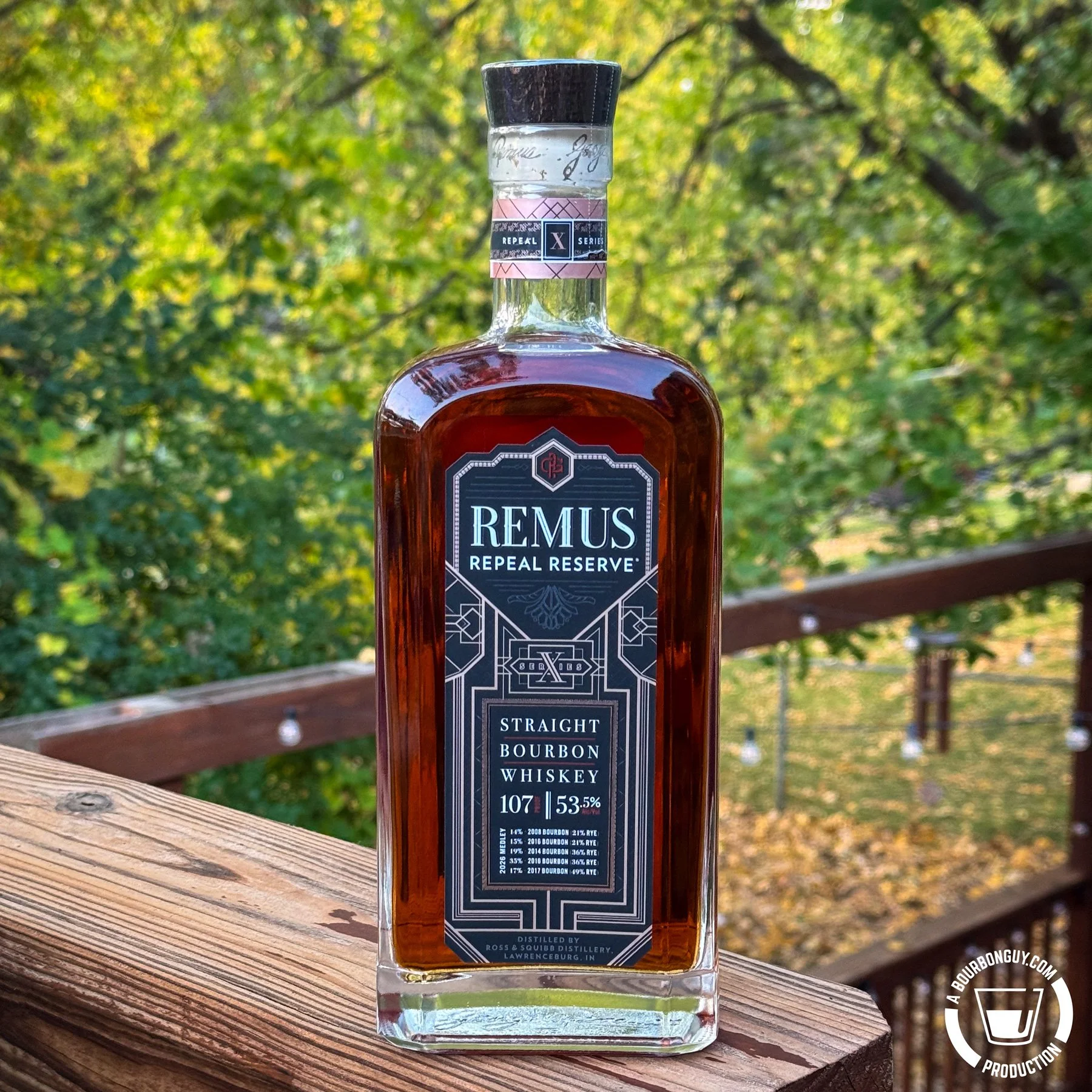
IMAGE: Close-up of a High West Cask Strength bourbon bottle on a snow-dusted wooden railing, showing the label with barrels illustration and amber whiskey, winter background softly blurred.

Hello friends! It’s been quite the month here in the BourbonGuy household, but we are seeing the light at the end of the tunnel, so let’s dig right in on the latest thing that the Whiskey Fairy has brought me.

Tonight’s whiskey is a new release from High West Distillery. A blend of straight bourbon whiskeys bottled at cask strength, this release was cleverly named Cask Strength. It looks to have been officially released on January 12th. It is listed as “Bottled by High West Distillery,” but as usual with whiskey that High West has sourced, they are as transparent as can be about what is actually in the bottle. Here is the breakdown of the mash bills:

  • 60% Corn, 40% Malted Barley, sourced from a Kentucky distillery

  • 60% Corn, 40% Rye, sourced from a Kentucky distillery

  • 75% Corn, 21% Rye, 4% Malted Barley, sourced from a Indiana distillery

  • 78% Corn, 10% Rye, 12% Malted Barley, sourced from a Kentucky distillery

  • 84% Corn, 8% Rye, 8% Malted Barley, sourced from a Tennessee distillery

The product was bottled at 117 proof and will be available as a limited release nationwide at a suggested retail price of $69.99. Here is what Distilling Director Isaac Winter has to say about the release:

"This was a really fun blend to put together. Building on our high-rye blending philosophy, this Cask Strength expression uses our Bourye blending approach to precisely balance rye-driven spice with malted barley richness, resulting in layered complexity and a bold, lasting presence that keeps you coming back.”

Let’s dig in, shall we?

High West Cask Strength Bourbon

Purchase Info: This product was provided at no charge for review purposes. The suggested retail price is $69.99 for a 750 mL bottle.

Price per Drink (50 mL): $4.67

Details: Batch 25K14. A blend of seven straight bourbons from Kentucky, Indiana, and Tennessee. 58.5% ABV. Non-age stated.

Nose: Cinnamon, clove, caramel, almond, and oak.

Mouth: Drying in the mouth. Black tea, cinnamon and clove, stone fruits, almond, and oak.

Finish: Long and very warm. Notes of oak, almond, chocolate, and cinnamon.

IMAGE: A hand-drawn smiley face denoting that I like the product.

Thoughts: I’m not the biggest fan of this one neat. It’s drier than I’d prefer, very hot, and the alcohol notes are a bit too prominent for me. However, add just the tiniest splash of water or ice and it goes from hot and dry to velvety. It becomes sweeter as the caramel and stone fruit notes start to show. The baking spice notes become more generic, but the oak steps forward a bit. All in all, this is a pour that benefits from a little water—which is how I usually enjoy my bourbon anyway. It’s also delicious in both a sour-style cocktail (I did a Gold Rush) and a spirits-forward cocktail (I did a Boulevardier). I really like it.


Before we finish, I want to apologize for ghosting everyone last week. Between both of my dogs being on hospice care, the assault on my adopted home state of Minnesota by the federal government (it’s been worse than what even the local news has reported), and a long-overdue discussion that led to a Festivus-style airing of grievances—one that nearly had me cutting ties with both of my parents over the holidays—I’m in the middle of quite the mental breakdown. Possibly my biggest in about 15 years.

I’m OK. I’m not a danger to myself or anything like that. But it was all a bit too much for me to try to be witty and creative for most of the month of January. I’m getting the help I need, but if you or someone you love is experiencing a mental health crisis, help is available.

U.S.: Call or text 988 to reach the 988 Suicide & Crisis Lifeline — free, confidential support available 24/7. You can also visit 988lifeline.org for chat support and additional resources.

Outside the U.S.: Visit findahelpline.com to find local crisis hotlines by country.

From the BourbonGuy Archives: What's With All the Weird Faces? Why I Don't Rate Whiskeys Like the Usual Whiskey Person

Folks I seem to have picked up a little tummy bug that has kept me from doing any tasting notes this week. So instead of leaving you hanging, I’m bringing back a reminder of what our ratings mean from the archives. It’s been a few years so this will help out all the new folks. See you next week!

IMAGE: The four images I use for Ratings. A Heart means I love it. A smile means I like it. A Neutral face means I can see why others might like it, but it's not for me. A Frown means this is bad and I really do not like it.

What the hell is with all the funny faces? Why can’t you do something useful like give a whiskey a number score? You know, even a 1-10 would help us know if this whiskey is better than another whiskey.

This is just a small sampling of the sentiments I get in my email now and then. Don’t get me wrong, I love the passion that it takes to take the time to write to me. Hell, I just like to know that people are reading this. But as it has been…five years (?!? where has the time gone?) since I last wrote a post like this, I thought it might be time to explain my silliness to all of you who are new.

By the way, if you arrived in the last five years, WELCOME! The bar is in the corner, please pour yourself something nice from the fancy shelf.

So. Why don’t I use numerical scores? Well, everyone who writes about whiskey approaches things differently.  Some reviewers like to use numbers. Numbers make a review feel scientific because you've done some math. Some reviewers like to use stars. Stars are easy to visualize and are familiar to Amazon shoppers everywhere. I like to use various cartoon faces and hearts because I'm silly. Probably too silly for my own good. The point is that any and/or all of these are correct. They all adequately represent how much or how little a reviewer liked any given whiskey. But no matter how a writer presents it, we as readers need to remember that the rating is still just a subjective opinion. Whiskey is subjective. There is no objectively bad whiskey. Someone out there likes everything that has been produced and they should not be shamed for that, even if you don’t agree with them.

It probably goes without saying, but I like Bourbon, Rye, Canadian whisky, craft whiskey, Irish whiskey, Gin, and a lot of cocktails. As a general rule, I don’t really like Scotch Whisky, though there are exceptions. Am I wrong that I don’t care for Scotch? No. My taste buds apply only to me. This is what I mean when I say there is no objectively bad whiskey, just whiskey that I don’t like. I’m not here to tell you if you should like a whiskey, only if I do or don’t. I judge whiskey, not people.

So, I like bourbon. I enjoy it in many different ways. Sometimes I enjoy thoughtfully tasting bourbon. I pour it into a nosing glass, sit down, concentrate, and try to tease out all the little smells and tastes that are hidden inside the glass. And if it is interesting, I'll probably like it. Other times, I want to enjoy bourbon in a rocks glass while playing cards or watching tv or conversing with friends. I'm not paying a lot of attention to it, but if it tastes good and it's acting as a social lubricant, I'll probably like it. Sometimes I enjoy it in a cocktail. Even if it isn't great neat, if it makes a killer Manhattan, I'll probably like it. And if I like it, then I'll tell you I like it. And then I'll put a little smiley face next to my thoughts on it. 

Sometimes I find a bourbon that doesn't taste good and isn't all that interesting. Needless to say, I don't like these. I've gotten pretty good at knowing what I like, and since I buy a good percentage of the whiskey reviewed on the site, the odds are that I'm not buying too many duds. But occasionally one slips through, or I buy one specifically for research purposes. When that happens, I'll tell you I dislike it and put a little frowny face next to my thoughts.

Of course, some whiskeys are just...meh. There is nothing offensive about them. They don't taste bad. I don't dislike it, but I don't like it either. I can see why others might like it, but it's just sort of in the middle there for me. Just not to my tastes. In such a case I'll just drop a neutral face on it.

Very occasionally I'll drop a heart on something. This means I love it. No ifs, ands, or buts. I'd take this whiskey over almost any other. 

So to recap:

IMAGE: The heart I use to show I love a whiskey.

A heart means I loved this whiskey. I'd have to pause and think (briefly) if forced to choose between it and my wife. (shhhh... don't tell her)


IMAGE: A Smile that I use to say i like something.

A smiley face means I liked the whiskey or I found it interesting while tasting it. Or I enjoyed myself while drinking it. Or I enjoyed the company I drank it with. Or I was having fun. Most bourbons and ryes will be in this category because, on at least some level, I like most bourbons and ryes I've tasted.


IMAGE: A neutral face I use to show that this whiskey is kinda meh.

A neutral face means meh. I didn't particularly like this whiskey, but I didn't hate it either. It wasn't for me. But you might like it.


IMAGE: A Frown with it's tongue out and x'd out eyes means I disliked this whiskey.

A frowny face means I really disliked this. I probably dumped it out or at least thought about dumping it out.


We all have different life experiences that color our perceptions. If you drink moonshine exclusively and you age it to a young age, that young whiskey may taste amazing to you. If however, you gave that very same whiskey to a person who exclusively drinks 12-year-old bourbon, they will probably vehemently disagree. The same thing goes for tasting notes. They are each informed by our own life experiences. I taste JuicyFruit gum when I taste Four Roses. Other people might taste Jackfruit, but I've never had a Jackfruit, so I say JuicyFruit. Some people might taste almond in a whiskey. I'm allergic to nuts, so I only have an academic idea of what almonds taste like. If I use it as a tasting note, it will have come from my wife (we do the notes together). The point is that everyone will like different things and has had different experiences to inform their tastes. And that's ok. In fact, it’s pretty cool. It gives us whiskey lovers something to talk about aside from the weather.


Did you enjoy this post? If so, maybe you’d like to buy me a cup of coffee in return. Go to ko-fi.com/bourbonguy to support. And thank you, BourbonGuy.com is solely supported via your generosity.

Of course, if you want to support BourbonGuy.com and get a little something back in return, you can always head over to BourbonGuyGifts.com and purchase some merch. I’ve made tasting journals, stickers, pins, and more.