
Bottom-Shelf Bourbon Brackets 2016, Round 1: Fighting Cock vs. Buckhorn

Round 1a of the 2016 Bottom Shelf Bourbon Brackets features Number 1 seed, and last year’s winner Fighting Cock versus Number 4 seed Buckhorn. 

Fighting Cock is a product of Heaven Hill Brands. It was initially chosen as a part of last year’s competition where it eked out a narrow victory over Heaven Hill’s Evan Williams Bottled in Bond. Of course when it competed last year, it had an age statement of 6 years old. This year, when it comes back to defend it’s crown against new competition, it is sporting no age statement. Can it become a two time winner even with that handicap?

Buckhorn is a Total Wine exclusive.* It is sold to them by the Clear Spring Distilling company, an assumed name that Sazerac uses to make house brands. It is 80 proof and carries no age statement so it is at least 4 years of age. I was leery about including it in the competition since you’ll need to be near a Total Wine to get one, but I’m going assume that if you substitute another NAS house brand made by Sazerac under the Clear Spring name, you might get fairly similar results.

These were tasted blind in the following order. My thoughts on each are from before the reveal.

Fighting Cock

Purchase Info: $14.99 for a 750 mL bottle at Total Wine, Burnsville, MN

Details: 51.5% ABV, No age statement

Produced by: Heaven Hill Brands

Nose: Bubble gum, mint, cooked cereal

Mouth: Hot and grainy. Hints of caramel and a touch of oak underneath.

Finish: Hot and grainy with a lingering dried corn bitterness

Pre-Reveal Thoughts: “If this is the fighting Cock, it took a huge dip when it went NAS last year.”

Buckhorn

Purchase Info: $12.99 for a 750 mL bottle at Ace Spirits, Hopkins, MN*

Details: 40% ABV, No Age Statement

Produced by: Clear Spring Distilling Company (Sazerac)

Nose: Herbal. Brown sugar, mint and oak.

Mouth: it basically follows the nose. Herbal, brown sugar, mint and delicate oak notes.

Finish: Middling finish with a bit of heat but not much length. Lingering herbal notes.

Pre-Reveal Thoughts: “Nothing offensive on this one, I’d take a glass if offered.”

Who wins?

The finish on Fighting Cock is better heat wise but falls way short on flavor. I’m not a fan of really grain forward finishes. In the mouth it’s the same. Fighting Cock is hot but Buckhorn is more flavorful in the ways I like my whiskey. If Buckhorn had some of Fighting Cock’s heat, this contest would be a no brainer. As it is, I’m leaning Buckhorn but could understand why others with different tastes would go the other way. But I’m the judge so it looks like we’ve just had the first upset in the history of the Bottom-Shelf Bourbon Brackets because 4 seed Buckhorn just knocked off last year’s champ. 

Well a non-age stated version of last year's champ. Apparently after removing the age from the product, Heaven Hill was hoping that the high proof would cover the degradation of the aged flavors. They were wrong. Last year I advised not to add water to it as it minimized the oak and the heat and left you with just grain flavors. Now you can get that without adding water. It's too bad. This used to be a hidden gem as little as a year ago. 

*Not so exclusive. By a quirk of Minnesota law, liquor stores are prohibited from carrying exclusive products. This means many local stores buy the exclusives and then undercut Total Wine’s price. Which is nice since these products tend to have the highest markup at Total Wine. Everyone wins…well except the massive megaretailer. As an example, I bought this one at Ace Spirits.


BourbonGuy.com accepts no advertising. It is solely supported by the sale of the hand-made products I sell at the BourbonGuy Gifts Etsy store. If you'd like to support BourbonGuy.com, visit BourbonGuyGifts.com. Thanks!
Bottom-Shelf Bourbon Brackets 2016: The Brackets

Its that time of year again. The time of year when in the spirit of the season, America pretends to enjoy college basketball. The time when intraoffice gambling on the backs of unpaid athletes is not only condoned, but practically expected. The time when paper or online brackets are filled, mostly with guesses because what normal person really knows what the hell a Gonzaga is anyway. 

I’m not immune to the lure. But instead of trying to figure out whether a Holy Cross can beat a Southern University, I’d rather spend my time figuring out if I like Evan Williams 1783 or Wild Turkey 81 proof better. Because honestly I really don’t like basketball. Plus I work out of my home so I have no coworkers with whom to pretend that I care whether an FGCU wins or not.

Because I am a frugal person, this annual competition started out as a way to find new inexpensive bourbons with which to drown my sorrows as I waited for winter to end. But with both winters and inexpensive bourbons that I haven’t tried are becoming increasingly rare, I actually was worried that I wasn’t going to be able to find enough bourbons to qualify this year. 

But there is good news frugal fans of bourbon! Minnesota is smack dab in the middle of the Total Wine effect. Items that didn’t qualify in years past are now priced within reach due to the increased price competition and items that were intended to be store exclusives are now being stocked on store shelves across the Metro. Prices are dropping and selection is rising. And this makes this year’s brackets a little more interesting than normal.

As it has been a year since we did this last, let’s go over the guidelines for selection: 

  1. I'm defining Bottom-Shelf as under $20 per liter or $15 per 750 mL bottle.

  2. It must be Straight Bourbon

  3. It must be available in Minnesota

  4. I am hoping to try new things so when possible, I looked for things I hadn’t reviewed before.

After the bottles were purchased here are the guidelines I used to seed them. 

  1. Previous Winners. JW Dant Bottled in Bond won two years ago and Fighting Cock won last year year so they get an automatic #1 seed.

  2. Stated (or assumed age). Straight bourbon has to be at least two years old. But unless it is under four years old you don’t have to put an age on it. So if someone does it’s either a good thing or a bad thing. I like to reward good things and punish bad things.

  3. Proof. Higher proof often equals better flavor. Not always, but it can be a good rule of thumb.

  4. Minimize corporate cousins. I figured I could introduce a little more difference into each initial pairing if they didn’t come off the same still, or at the very least wasn’t sold by the same company. Since four of these are from Heaven Hill and two are originally from Sazerac, it's a guideline, not a hard rule, and is overridden by the above guidelines.

So who are the contestants? Well, as mentioned above, Fighting Cock and JW Dant are our return winners so they get the number one seeds in each division. There were no age stated bottles this year so that one has been set aside, though I did knock Very Old Barton down a notch for their misleading “6.” So the next two highest proof bottles are Evan Williams 1783 and Very Old Barton 6 are both 86 proof and they become the number 2 seeds. After that the newly renamed Wild Turkey bourbon is 81 proof so it becomes our first 3 seed. The last three were dropped in what I thought might be an order to provide the most interesting match ups with Jim Beam White becoming the last 3 three seed going against Barton while Buckhorn (a Total Wine “exclusive” from Buffalo Trace) and Heaven Hill’s Blue State picking up the slack as 4 seeds.

Due to the Total Wine effect, this was an interesting year. Stay tuned.


BourbonGuy.com accepts no advertising. It is solely supported by the sale of the hand-made products I sell at the BourbonGuy Gifts Etsy store. If you'd like to support BourbonGuy.com, visit BourbonGuyGifts.com. Thanks!
The Worst American Whiskies I've Had

I’ve said it before. I don’t review a lot of bourbon that I don’t like. You might think I am too Minnesotan and don't want to say anything mean or that maybe I don’t have a discerning palate. You might think that I’ve been bought off or that I’m hoping to get free whiskey. You might think a lot of things, but unless you are a long time reader, you’d probably be wrong.

You see, there is a very simple explanation for why I don’t review a lot of bourbons I dislike. I buy almost all of the whiskey I review and I really don’t want to spend money on things I’ll dislike. I’m experienced enough at buying American Whiskey that I kind of know what I like and what I don’t. Of course, that doesn’t mean I haven’t had a stinker or two slip through. And just because I didn’t buy it doesn’t mean that I haven’t tried it. 

So in the name of helping you to avoid the stinkers, and because I do get asked this on occasion, tonight I’m presenting you with my list of the 5 worst American Whiskies I’ve had. To qualify, I had to have had it and I have to have wished I hadn’t.

My 5 Worst American Whiskies

(as decided by me and in alphabetical order.)

Hayes Parker Reserve: Terre Pure bourbon aged at least six months. I made the mistake of picking up two minis of this. I think my wife’s comments sum it up perfectly: “You can’t make me put more in my mouth.” 

Masterson’s Straight Wheat and Straight Barley Whiskey: These are technically a set of Canadian whiskies, but since they are sold by a US company I’m going to include them here. When these were released, I made a comment about buying them and these are so bad that I had someone in another country volunteer to send me a sample of each so that I didn’t waste my money on them. To this day, I consider that lady to be a very good friend. I tried my samples in nosing glasses in a nice hotel room while feeling very relaxed. A good set up for being forgiving to a whiskey. It didn’t help. I struggled through half a sample of each before dumping them out and finding something tastier to get the flavor out of my mouth.

Rebel Yell: I bought this bourbon as part of the Bottom Shelf Bourbon Brackets the first year I did them. It lost in the first round to Old Crow Reserve. At the time, I said I didn’t know what I would do with the bottle because I wasn’t going to drink it. I’ve tried blending it, I tried cooking with it. Nothing worked. Eventually I did find a use for it. It became “Prop Bourbon.” When I need to take a photo for a review, but already finished the bottle, I pour my prop bourbon into the empty bottle for the photo. Afterward I dump it back into the Rebel Yell bottle and stick it back in the closet. 

Town Branch Bourbon: I have never purchased this bourbon, but I’ve given this a shot on numerous occasions. I keep thinking that it must just be me. But no matter how many times I come back to it, I just don’t like it. It’s a very pretty bottle, but what’s inside I find repugnant.  

Woodford Reserve Master’s Collection Double Malt Selection: This release was two different Malt Whiskies that needed to be purchased separately. I had them at a friend’s house in Louisville. We were both extremely excited to try them and well…he dumped his out. I tried to be polite and finish mine, but was convinced to do the same. This might be the worst thing Woodford has ever released under their name.

Dis-Honorable Mentions

These were also very bad whiskies, but for one reason or another I decided to drop them out of the main category. Either they weren’t quite as bad as the ones above or they are no longer available or available in such limited quantities that they won’t be much help to anyone.

11Wells Rye: This is a small craft distiller here in the Twin Cities. I tasted this at a local retailer along with a group of friends after an event. I also tasted it again at Whiskey on Ice, a local whiskey festival. It’s…not good. Hopefully after some time it will get better but I’ll need to be convinced of that when it happens.

Fleischmann’s Straight Rye: Only available as a plastic handle in Kentucky and Northern Wisconsin, this is not a whiskey to seek out. In fact, it’s not available even in those two places as a “straight” whiskey anymore, that part of the label having been changed. When I bought it, it was less than $12 for a 1.75 L bottle and it was over priced. 

Woodford Reserve Master’s Collection Sonoma-Cutrer Pinot Noir Finish: This is bad. If the Double Malt is the worst thing that Woodford ever put their name on, this is the second worst. I’ve had people tell me I’m crazy, but I found this to be terrible.

Yellow Rose Bourbon: I had this at a tasting event that was held at a local chain a couple years ago. My notes at the time mentioned musty, wet corn flakes. And unfortunately, the $70 price tag on a bottle won’t let me give them another chance. There is very little chance you’ll be seeing this on the site as a full-blown review.

So there you have it. Your list will probably be very different. We all taste things differently and we all like different things, but for me these are the worst American whiskies I’ve ever had. What about you though? What’s the worst you’ve had? Let me know in the comments.

UPDATE: So, after fourteen hundred and some odd days after I first made my opinion known on Rebel Yell, I finally got around to trying it again. Here are my updated thoughts: Rebel Yell: Revisited.


BourbonGuy.com accepts no advertising. It is solely supported by the sale of the hand-made products I sell at the BourbonGuy Gifts Etsy store. If you'd like to support BourbonGuy.com, visit BourbonGuyGifts.com. Thanks!
Whiskey: An American Pictorial History by Oscar Getz

A while back, I wrote a post about the Oscar Getz Museum of Whiskey History in Bardstown, KY. In doing research for that post, I stumbled upon the information that Mr. Getz, aside from being an avid collector of whiskey historical memorabilia, also wrote a book on whiskey history as well. 

Having stumbled upon that information just as the the monthly patron donations hit, I immediately decided to use that month’s proceeds to purchase the book should I be able to find it. It turns out that it I didn’t have to look too hard. Though the book is long out of print, there are plenty of used copies for sale on the Amazon Marketplace. And so, not knowing exactly what I would get, I placed the order and waited.

Whiskey: An American Pictorial History

by Oscar Getz

Based upon the title, I expected this book to be made up almost entirely of pictures. I expected that most of those pictures would be from Mr. Getz’s collection, the seed of the Oscar Getz Museum of Whiskey History in Bardstown, KY. I half expected that most of the images would be of things I remembered seeing from the museum.

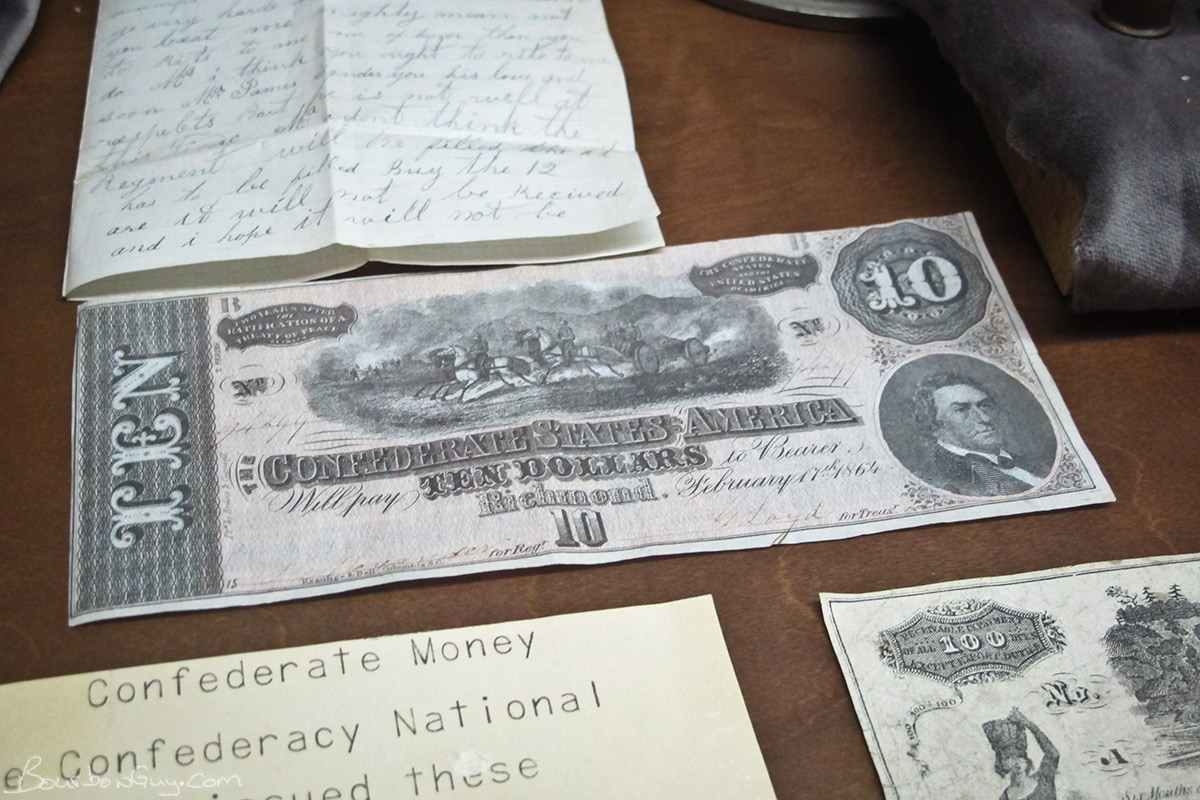
I was both right and wrong. There are images of items that I’ve seen in the museum and many of the images are of items from Mr. Getz’s collection. But contrary to my expectations this book is not as image heavy as the title would lead you to believe. Now don’t get me wrong, there are a lot of images, but many, if not most, of them are images of documents. Within it’s pages are an amazing collection of letters, laws, newspaper pages, liquor licenses and advertisements from Colonial times through the mid-1970s. 

Like other books on American whiskey history, this one starts with the pilgrims, retelling legends that in many of us learned in elementary school. It talks about the intertwined nature of taverns, liquor and the early United States. It touches on George Washington, Hamilton, the Whiskey Rebellion, the Civil War before ending it’s narrative with Prohibition. 

But though it hits all the same notes as many other books, I found this book to be interesting for the parts it includes that many others don’t. There is a chapter on Abraham Lincoln and his tavern. There is a chapter on mail-order whiskey marketing. And the book ends with a chapter on a subject that reads as a personal one for Mr. Getz, the economic and social contributions of the liquor industry. 

This final chapter details a history of charitable contributions, the many ways that states used their liquor tax revenue in the 1970s and a plea that the distilling industry devote itself to helping end teenage consumption as well as drinking and driving. Though this chapter was not written as a history, almost forty years on, it provides some interesting insights. 

Overall if you happen to see this book somewhere, I’d recommend picking it up. Though the text can be dry and hard to read at times, the information and documents contained in it’s pages are worth the effort.


BourbonGuy.com accepts no advertising. It is solely supported by the sale of the hand-made products I sell at the BourbonGuy Gifts Etsy store. If you'd like to support BourbonGuy.com, visit BourbonGuyGifts.com. Thanks!

Head to head: 1792 vs 1792 store pick

When you buy as much whiskey as I do, there will be times when you have multiples of a product. Either because you were afraid it would be out of stock soon, it was on sale with a deal too good to pass up or because you just felt like treating yourself and buying it. 

Yes. I have a bit of a shopping problem.

In any case I recently ended up doing exactly that last thing on the list. I was in the store, looking to grab a six pack of beer to serve with the pizza I was making for Friday night, when I noticed a rack of 1792 bourbon in the corner with a big sign at the top proclaiming it to be $23.99. When I got over there, I also noticed that it had a sticker on it proclaiming it to be a “Single Barrel Select” that had been selected for my local liquor store. (Yes, it says selected for, not by.)

A long time ago, I picked up a store selection of 1792 to compare to the base release and found almost no difference between the two. Frankly, I expected the same this time around, but it was a good price and, dang it, I wanted to treat myself. So I picked it up even knowing I had a bottle in the closet at home that I acquired at the Master Distiller’s Auction in Bardstown. But, trying them side-by-side, I was pleasantly surprised. The difference wasn’t huge, but it was big enough to be discernible. 

This is why I love whiskey. This sort of thing is so much fun!

1792 Bourbon: Regular Release vs Store Single Barrel (MGM Wine & Spirits)

Regular Release:

Purchase Info: ~$20, 750 mL bottle. Master Distiller’s Auction, Kentucky Bourbon Festival.

Details: 46.85% ABV

Nose: Spearmint, pear, cinnamon and oak.

Mouth: Soft mouthfeel with a lot of heat. Black pepper, mint, caramel/vanilla and oak. 

Finish: Hot and on the short side of medium. Lingering mint and black pepper.

MGM Wine and Spirits Single Barrel Select:

Purchase Info: $23.99, 750 mL bottle. MGM Wine and Spirits, Prior Lake, MN

Details: 46.85% ABV

Nose: Wet rock, soap, fruit, vanilla, oak and hints of mint.

Mouth: Not as hot and sweeter than the regular release with brown sugar and a generic fruitiness added to the black pepper, mint and oak of the regular release.

Finish: Warm, but on the short side with a lingering sweet fruitiness.

Thoughts: This is what I want when I grab a store pick and do a head-to-head. This is certainly within the 1792 flavor profile, but there are enough differences for me to notice. Actually, I could wish this was the profile of the regular release. Though it is good, I hesitate to buy 1792 normally because I like my bourbon a little on the sweet side with a little less heat than your normal 1792 brings along with it. This is slightly milder, and I think that for me it is just about perfect for that flavor profile.

I completely recommend that you do this experiment yourself if you get the opportunity. Buy a store pick (doesn’t have to be 1792), but grab the regular one too should you have the opportunity. Compare them. Decide which you like better. Figure out why. Because the list of variables here will be smaller, this experiment will go a long way toward helping you decide the sorts of things you like. And heck, it’s just plain fun.


BourbonGuy.com accepts no advertising. It is solely supported by the sale of the hand-made products I sell at the BourbonGuy Gifts Etsy store. If you'd like to support BourbonGuy.com, visit BourbonGuyGifts.com. Thanks!

The Oscar Getz Museum of Whiskey History

Have you ever been to Bardstown, KY? You really should go. It’s a small town at around 12,000 people or so. Most of those 12,000 people are fantastic. Helpful, nice people are the rule, not the exception. If you are looking for a bit of quiet, Bardstown is perfect. The stores downtown tend to close around five o’clock at night. The restaurants somewhere near ten. But the major thing Bardstown offers is that it sits smack dab in the heart of Bourbon Country. It’s a home to two major (and a couple small) bourbon distilleries and is a short drive from most of the rest.

Sitting just off of downtown is Spalding Hall. Spalding Hall was originally built in 1839 as part of St. Joseph’s College, the first Catholic College in Kentucky. As you drive down Stephen Foster Avenue, Bardstown’s main road, don’t feel too bad if you don’t notice it at first. It is tucked behind the Basilica of St. Joseph and the grounds of the current St. Joseph’s Preparatory School. But, if you turn onto 5th Street, you can’t help but notice it. A large green lawn with large trees fronts the large Federal style building. Though built as part of the college, it has served various functions over the years. It was a hospital during the Civil War, a seminary, an orphanage and a high school. It was placed on the National Register of Historic Places in 1973. Today it houses a restaurant and the Oscar Getz Museum of Whiskey History. 

Oscar Getz and his brother-in-law were whiskey brokers before and after Prohibition. When the whiskey business started to change, they bought the Tom Moore distillery in Bardstown so that they could be assured of a steady supply of whiskey for their brands and renamed it Barton. Being an avid fan of whiskey history, Getz collected whiskey memorabilia and created a small museum on the distillery grounds to house his collection. Chuck Cowdery tells us that museum was open to the public. After Mr. Getz died in 1983, his wife donated the museum to the City of Bardstown in July of 1984 and it was moved to Spalding Hall.

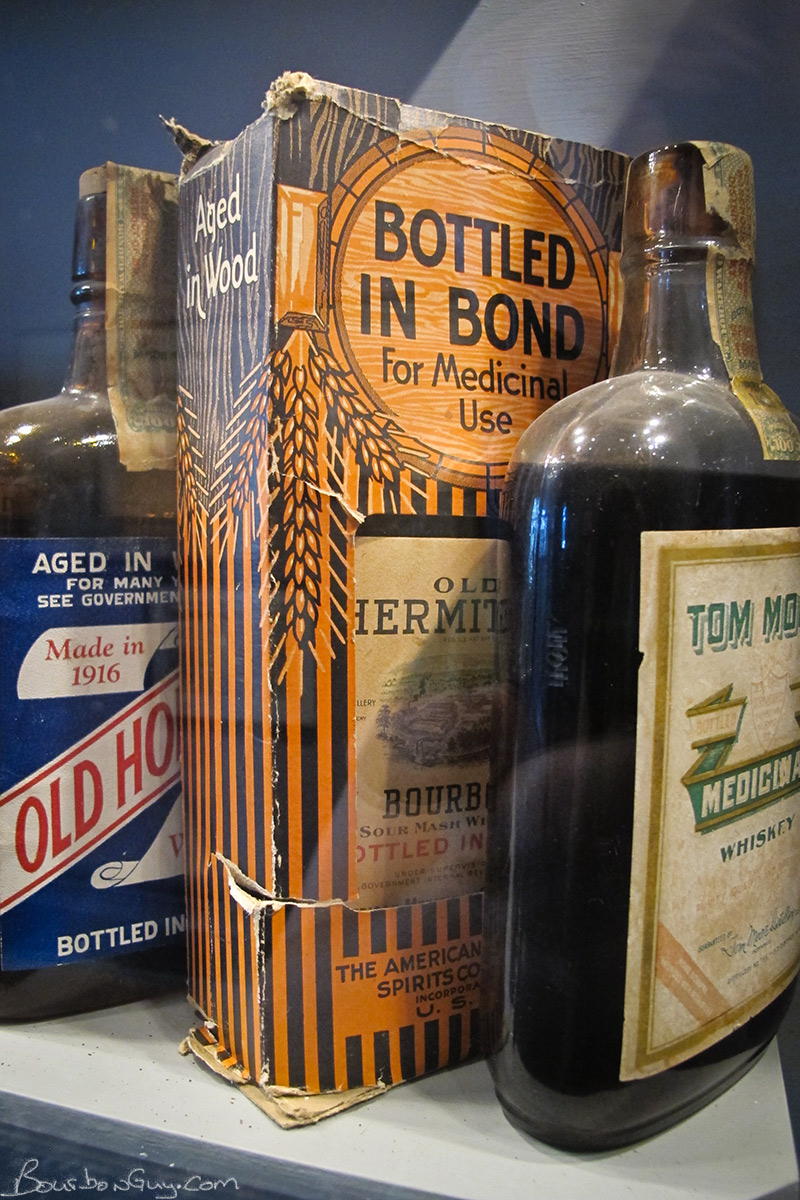
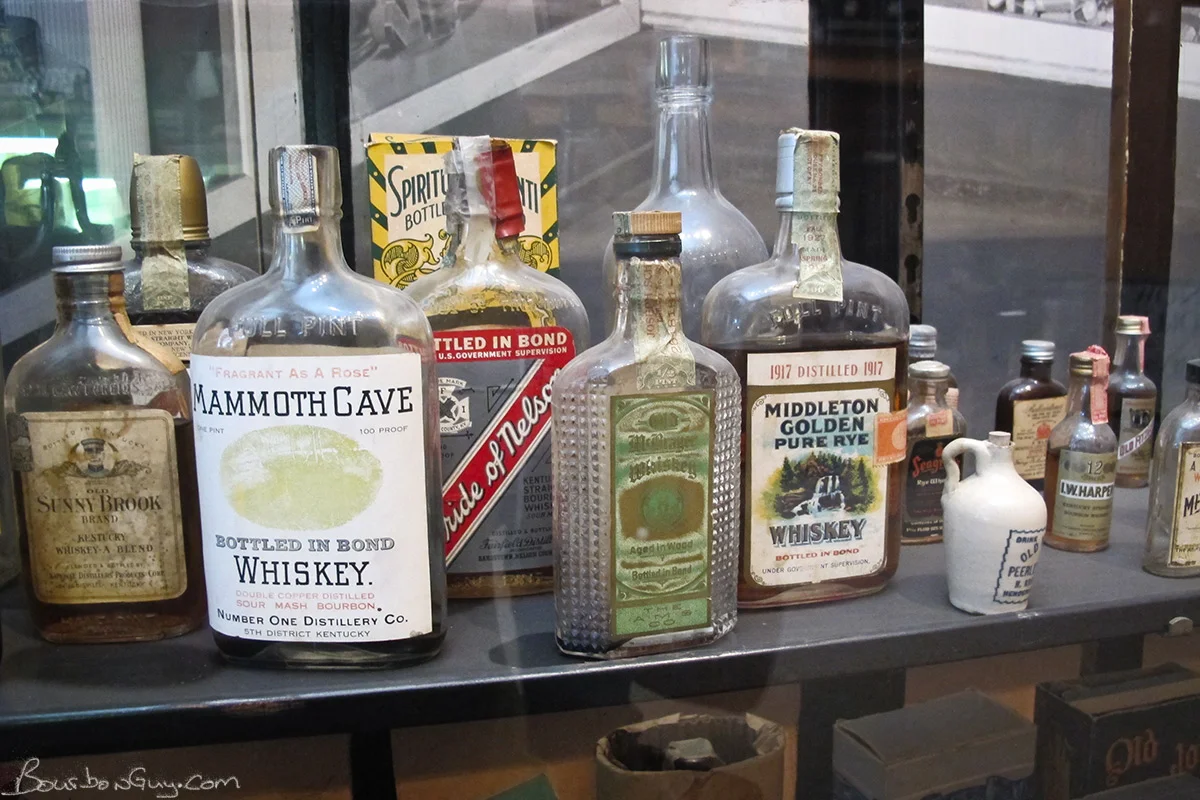
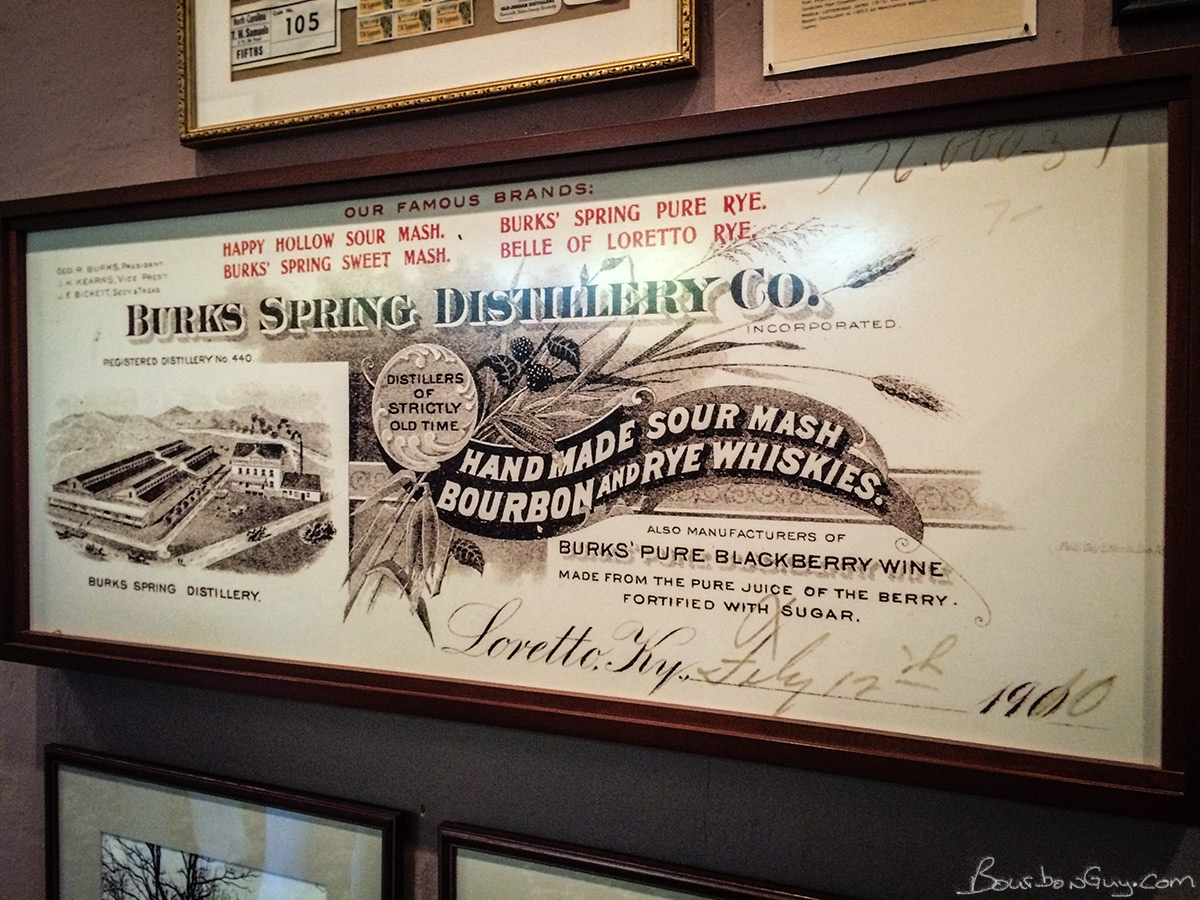
Today the Oscar Getz Museum of Whiskey History takes up most of the first floor of the three story building. There are two wings. The one to the left (as you enter the building) houses an exhibit on distilling and aging, a replica saloon, Abraham Lincoln’s liquor license, temperance and prohibition propaganda items and old bottles. Many, many old bottles. If you take a right, there are rooms that house exhibits that roughly trend around one or two of today’s major distilleries. Wild Turkey, Heaven Hill, Brown-Forman, Jim Beam, etc. Mixed in you will find more old bottles, labels, label printing plates, advertisements and much more. It really is a must stop for the bourbon lover who finds themselves in Bardstown. 

But there is a problem. The museum needs money. In talking to the volunteers, I found out that the museum doesn’t get any outside help. Though bourbon tourism is big business in Kentucky these days, drawing people in from all over the world, the state gives the museum no monetary help. And though it houses exhibits that are basically advertisements for many current brands, the distilleries don’t give the museum any money either. Though to be fair, I was told that Barton has a couple times in the past. Instead, the musuem funds itself through various other means. During my last visit, they had a table out selling old empty whiskey bottles. They’d had a large donation and were selling off ones they already had. I bought an Old Crow “traveler fifth” bottle and an IW Harper decanter bottle from the 60s for $5 each. 

Master Distiller’s Auction

The main way the museum funds itself is with the Master Distiller’s Auction held each year during the Kentucky Bourbon Festival. The auction is held in the chapel of the building. The auction is sponsored by the Van Winkles and provides most of the museum’s operating budget for the year. Items up for bid include old “dusty” bottles of bourbon, historical artifacts, signed bottles of special releases, gift baskets, and other interesting items. The items for sale are all donated. Most from the distilleries in the area.

I went to the auction for the first time last year and didn’t buy anything. This year on the other hand, we went in with a plan to come away with something. I was particularly interested in the dusties. Last year a few had gone at prices I could afford. This year, no such luck. A bottle of JW Dant and a bottle of Gibson’s Rye each from 1933 went for $1350 each, a quart of Old Sunnybrook from 1937 went for $500 and a pint of Prohibition era Crestmore bourbon went for $700. I was also interested in the prohibition whiskey prescriptions. Those went for about $200 each, also more than I wanted to pay. There were a couple of things I wish I could have bid on but knew I couldn’t afford and would have needed to be fairly local to use. One was a cocktail class by Joy Perrine that received no bids and that the auctioneer bought. The other was a tasting led by bourbon historian Mike Veach and that went for $400. 

I ended up getting a few things though. I bought an Old Forester gift box from 2008 commemorating the 75th anniversary of the Repeal of Prohibition for $95. I might have gotten a little carried away there, but it’s for charity so I didn’t mind overpaying some. But I also got a couple of things no one else wanted for less than retail. I got a bottle of 1792 plus a bottle of Bloody Kentucky bloody mary mix for $40 and a bottle of Wild Turkey Diamond plus a set of four glasses for $140. Overall I felt good knowing the money was going to support the museum and I got a couple things I would drink.

Of course the really big money was reserved for more current releases of Whiskey. Yep the Pappy was the big money prize of the day. A signed bottle of Pappy 23 came in at $1600, the 20 was $1150, 15 year old went for $900, the Old Rip Van Winkle 12 year for $750 and the 10 year for $425. Overall, as befitting the corporate sponsor, Van Winkle  bourbons brought in more than one quarter of the $17,000 that the auction brought in for the museum.

I really recommend that if you find yourself in Bardstown, you visit the Oscar Getz Museum of Whiskey History. It’s free to visit, though there is a donation box. The building is old, the exhibits are old, the stuff inside the exhibits is old. But in this case, that’s a good thing.


BourbonGuy.com accepts no advertising. It is solely supported by the sale of the hand-made products I sell at the BourbonGuy Gifts Etsy store. If you'd like to support BourbonGuy.com, visit BourbonGuyGifts.com. Thanks!

Two Stars Bourbon

Here we have a bourbon that I have made fun of every time I walked though the bourbon section of Total Wine. I mean it’s hard not to. 

“Only two stars? Wow, don’t set your sights too high there.”

“Two stars? Wait, is this an actual honest bourbon label?”

“Two Stars. Because four stars costs too damn much and you wouldn’t appreciate them anyway.”

Stuff like that. But in my never ending quest to find bourbon diamonds in the rough, I finally decided to take the leap and buy it. Before I did though, I picked up the bottle and took a hard look at what I was buying. 

First off, it looks like the same bottle that Weller and Very Old Barton come in. I’ve seen other store brands made by Sazerac that use that same bottle so that was something. Second it is an 86 proof, straight bourbon with no age statement. So that means it is at least four years old. Seems ok so far.

Made by Clear Spring Distilling Co. in Louisville. I admit this through me for a loop at first, but a quick search lead me to this: Clear Springs Distilling Company???. And then the COLA. Yep, it seems that Clear Springs is an assumed business name that Sazerac uses to make house brands. 

The bourbon at least stood a shot of being ok, so I picked it up. Unlike normal, immediately upon returning home I opened it and took a sniff straight from the top of the bottle. I was really leery of this one for some reason, maybe it was the name. It smelled ok, so I splashed a little in a glass and took a sip…and was shocked at how not terrible it was.

Two Stars Handcrafted Kentucky Straight Bourbon Whiskey

Purchase Info: $17.99, 750 mL. Total Wine, Burnsville, MN

Details: 43% ABV. Produced by at the Barton distillery by Sazerac.

Nose: Caramel, vanilla, cinnamon gum, mint.

Mouth: Starts with a nice spicy tingle that dances across my tongue. Cinnamon and cloves. Dry, with more than a touch of oak.

Finish: Lingering tingle in the mouth, dry with mint and oak.

a neutral face since I find this a bit meh.

Thoughts: Well, this certainly lives up to it’s name. I don’t care if Total Wine claims it is named for the municipal flag of Louisville, this seems to have been named with it’s mark of quality built in. It is not a four-star bourbon. It is however a very solid two-star. It works well as a mixer and can even function neat in a pinch. It’s not a bad price either at less than $20 for a 750 mL. 

Overall, keeping all that in mind, I’d recommend giving this one a shot. You might like it and if the worst that happens is that you are left with a bottle to use for making cocktails, that isn’t so bad either.

UPDATE: A previous version of this story incorrectly hypothesized that this bourbon might have been produced at Buffalo Trace. They have reached out to inform me that it is instead made at the company's Barton Distillery in Bardstown, KY. The story has been updated to reflect that change.


BourbonGuy.com accepts no advertising. It is solely supported by the sale of the hand-made products I sell at the BourbonGuy Gifts Etsy store. If you'd like to support BourbonGuy.com, visit BourbonGuyGifts.com. Thanks!

Sazerac: just remove the damn numbers

In my real life, I work in marketing. I’ve spent every day for the last 12 years trying to get people to buy things. Sometimes it was hammers as I did ads for hardware stores. Sometimes it was expensive medical equipment when I worked for an ad agency that specialized in such things.

Marketing gets an often undeserved bad reputation. We are the ones who have studied how to convince people of things. And since those things almost always involve money, we get the blame when we do our job too well. 

As a designer, I’m hyper-aware of the difference between convincing people and tricking them. I skirt the line almost all the time and I get extremely upset when I’m asked to cross it. I never forget that the people I’m convincing are actually people. It’s easy to reduce customers to numbers. To see them as nothing more than a line on a spreadsheet. Especially since when the numbers get bigger, you know that your paycheck is safe for at least a little longer.

So it was with extreme agitation that I noticed a sneaky little trick that the Sazarac company was pulling. I first became aware of it when the Fleischman’s Rye label went from saying “Straight Rye Whiskey” to saying “Mash Rye Whiskey.” I believe it’s supposed to be read as Rye Mash Whiskey, but that’s because the designer was either asked to do it wrong or convinced themselves that the larger rye would draw attention first.

I got angry when I found that I liked the Old Charter: Aged 8 Years and realized it had sneakily been replaced by something labeled: Old Charter: 8. The marketing department had removed the words Aged and Old, but left the 8. They tricked me. I was angry. I decided to to prove that they were sneaking an inferior product into the supply chain and trying to trick the numbers…err…customers into believing that nothing had changed. 

By an odd coincidence, I bought one out of the last batches of Very Old Barton, 100 proof: 6 Year Old before the switch to “Very Old Barton, 100 proof: 6.” So the last time I was in Kentucky I picked up a bottle of the 6. I’ll be very honest I had an agenda. I wanted to prove that these guys were no good liars.

On Sunday, I set up a double blind tasting with the 6 Year Old and the 6. I threw in a pour out of the bottle of 90 proof 6 year I had on hand to confuse the issue even more. Below are the results. 

Disclaimer: I bought all of these bottles. The 90 proof was bought at Binny’s in Bloomington, IL. The 100 proof NAS was purchased at Liquor World in Bardstown. The 100 proof 6 year old..I’m guessing it was at a Liquor Barn, but it was long enough ago that I don’t remember which one. I’m leaving this info out of the notes so as not to tip my hand as to which is which.

Bourbon 1

Nose: Sweet. Bubblegum. Grassy. Dried corn.

Mouth: Hot and sweet. Like a sugar cookie mixed with grain.

Finish: Some warmth. More dried corn. 

Bourbon 2: 

Nose: Predominately a lumber pile. Oak. Under that is some bubblegum.

Mouth: Thin. Dried Corn. A bit of bubblegum. 

Finish: Gentle, but with a lingering bitterness.

Bourbon 3: 

Nose: Vegetal silage. Sweet bubblegum. Oak.

Mouth: Some heat. Bitter oak tannins. Vegetal. 

Finish: Silage. Gentle. A lingering unpleasant bitterness.

Thoughts: Upon finishing my notes, I’m positive I know which are which. I’m guessing the thin mouthfeel of 2 means it is the 90 proof. And because of my bias, I’m pretty sure the vegetal silage one is the NAS and the sweet tasty one was the older version. 

I was correct on the 90 proof. That was indeed number 2. But I had the others completely backward. It turns out, I really disliked the 100 proof age stated version (number 3). It was bitter and tannic. And this isn’t a new phenomenon. I liked the 86 proof much more than the 100 the last time I reviewed them. But the NAS version (number 1)? I liked that one a lot. It was sweeter but still had the burn that let me know the proof was there.

So what does this mean? Well it lends credence to Sazerac’s claim that they wanted to age these to taste not age. If the 6 year is overaged, I’m happy to have one that isn’t. But I’m torn. They are still deceiving people. I hate being tricked almost more than I hate bad whiskey. But I have a solution.

Sazerac: just remove the damn numbers.